
Alle Artikel
LLMOps – ein neuer Aspekt des Platform Engineering
Wer LLMs produktiv betreibt, muss Skalierbarkeit, Zuverlässigkeit, Observability und Kosten neu denken – und macht LLMOps damit zu einem festen Teil des Platform Engineering.
·
Lucas Brüning

Hinweis: Dieser Beitrag wurde aus dem Englischen übersetzt. Fachbegriffe, Code und Befehle wurden bewusst im Original belassen.
Was ist LLMOps
Wie die meisten LLM-Technologien ist auch LLMOps sehr jung – nahezu täglich kommen neue Technologien, Werkzeuge, Architekturen und Änderungen hinzu. Das erschwert es, eine belastbare Definition zu finden und den Umfang von LLMOps sauber abzugrenzen.
Allgemein kombiniert und erweitert LLMOps Prinzipien aus MLOps und DevOps um LLM-spezifische Aufgaben, damit LLM-Systeme auch im großen Maßstab zuverlässig, sicher und kosteneffizient bleiben. Damit beschreibt LLMOps die Disziplin, große Sprachmodelle in verschiedenen Umgebungen bereitzustellen, zu überwachen, abzusichern, zu bewerten und zu pflegen. Das unterstreicht, wie wichtig LLMOps für einen stabilen Betrieb von LLMs und LLM-Workflows ist. Für ein besseres Verständnis müssen wir einen gemeinsamen Rahmen dessen abstecken, was LLMOps leistet und können sollte.
Umfang
Modell-Deployment und Model Serving
LLMOps dient dazu, die eigentlichen LLMs in verschiedenen Umgebungen bereitzustellen und auszuliefern. Beim Betrieb selbst gehosteter LLMs gehört dazu auch der Aufbau der nötigen Infrastruktur, um GPU- (oder andere Beschleuniger-) und CPU-Workloads sachgerecht zu bedienen und bei Bedarf zu skalieren. Das Deployment schafft in der Regel zugleich eine Multi-Model-Routing-Strategie, mit der sich bestimmte Anfragen automatisch an unterschiedliche Modelle leiten lassen. So könnten wir einfachere Aufgaben an kleinere Modelle weiterreichen, um die Kosteneffizienz zu verbessern. Mit Multi-Model-Routing lässt sich zudem eine sinnvolle Load-Balancing- und Failover-Strategie umsetzen, was Skalierbarkeit und Zuverlässigkeit in Produktivsystemen erhöht.
Es empfiehlt sich, ein AI Gateway einzurichten, um Routing-Regeln für Modelle zu konfigurieren und eine zentrale API für verschiedene LLM-Anbieter oder selbst gehostete LLMs bereitzustellen. Ein Beispiel für ein AI Gateway ist das Open-Source-Projekt „LiteLLM”, das wir in einem anderen Blogbeitrag mit all seinen Vorzügen und Fähigkeiten bereits behandelt haben.
Observability
Ein weiterer wichtiger Aspekt einer LLMOps-Plattform ist eine Observability-Schicht für unsere LLMs. Wir müssen die bislang üblichen Metriken – etwa Ressourcen- und API-Nutzung oder die Gesamtverfügbarkeit des Systems – um LLM-spezifische Kennzahlen ergänzen. Dazu können die Latenz der Modellantworten, die GPU- und CPU-Auslastung sowie die verbrauchten Input-, Output- und Reasoning-Tokens zählen. Anhand des Tokenverbrauchs kann ein LLMOps-Observability-Stack die Kosten der Modell-APIs präzise berechnen – eine weitere wichtige Kennzahl.
Über Systemmetriken hinaus sollte Observability auch die Qualität der Modellinferenz und die Qualität der Retrieval-Augmented Generation (RAG) abdecken, um Leistungseinbußen im Zeitverlauf zu erkennen. Für die Modellqualität kommen Kennzahlen wie Halluzinationsrate, sachliche Korrektheit, Antwortrelevanz, Konsistenz über wiederholte Abfragen hinweg und Nutzerfeedback-Signale infrage. Für RAG-Systeme zählen Precision und Recall des Retrievals, Kontextrelevanz, Grounding (also wie gut Antworten durch die abgerufenen Dokumente gestützt sind) und die Quellentreue der Antworten zu den zentralen Indikatoren.
Ein weiterer aufschlussreicher Baustein der LLMOps-Observability kann das Monitoring und Tracing auf Agentenebene sein. Moderne KI-Agenten nutzen eine Reihe von Werkzeugen und können sogar Sub-Agenten starten. Um Ausgaben, Verhalten und Qualität von Agenten sauber zu beobachten und zu debuggen, muss jede Aktion eines Agenten nachvollziehbar erfasst werden. Dazu gehören die Trefferquote bei der Werkzeugauswahl, Erfolgs- und Fehlerraten der Werkzeuge, Ausführungslatenzen und die Zwischenschritte des Reasonings. Dies ermöglicht zugleich die Erhebung von Metriken für die vom Agenten genutzten Werkzeuge.
Kosten- und Performance-Optimierung
LLM-Systeme können schnell teuer und langsam werden – vor allem im großen Maßstab oder wenn Agenten pro Anfrage mehrere Tool-Aufrufe ausführen. Kosten- und Performance-Optimierung ist daher ein zentrales LLMOps-Handlungsfeld. Ziel ist es, die Kosten je Anfrage und je Token zu senken und dabei Latenz- und Zuverlässigkeitsanforderungen einzuhalten.
Zu den gängigen Strategien zählen das bereits erwähnte Model Routing und Multi-Model-Setups, bei denen einfachere Anfragen von kleineren, günstigeren Modellen bedient und komplexe Aufgaben an leistungsfähigere Modelle weitergeleitet werden. Das verbessert bei kleineren Anfragen auch die Performance deutlich. Semantisches Caching, umgesetzt über RAG-Operations, kann redundante Aufrufe reduzieren, indem Antworten für ähnliche Anfragen wiederverwendet werden. Prompt-Komprimierung und Context Engineering senken den Tokenverbrauch, was sich unmittelbar auf Kosten und Latenz auswirkt. Token-Budgets und harte Limits verhindern übermäßig große Prompts und schützen vor unerwarteten Ausgaben.
Performancegewinne lassen sich zudem durch Request Batching, automatische Skalierung der Recheninfrastruktur und die Wahl optimaler Server und Regionen erzielen. Ein Observability-Stack ist unverzichtbar, um belastbare Erkenntnisse darüber zu gewinnen, wo Zeit und Kosten anfallen.
RAG Operations
Retrieval-Augmented Generation (RAG) ist eines der verbreitetsten Muster, um LLMs mit Unternehmenswissen zu verbinden. Statt sich darauf zu verlassen, dass das Modell interne Fakten „kennt”, ruft das System relevante Dokumente aus einer Wissensbasis ab und übergibt sie an den Prompt. Es kann eine Alternative zum Fine-Tuning eines Modells sein – mit dem Vorteil, dass weniger Rechenleistung und weniger Datenpunkte nötig sind. RAG lässt sich außerdem nutzen, um semantisches Caching aufzubauen und so Latenz und Kosten des Modells zu senken.
Es gibt verschiedene RAG-Varianten mit unterschiedlicher Komplexität und unterschiedlichem Umsetzungsaufwand. Klassisches RAG stützt sich auf Vektorähnlichkeitssuche, während fortgeschrittenere Ansätze wie GraphRAG strukturierte Wissensgraphen einbeziehen, um Reasoning und Kontextabruf zu verbessern. Eine weitere Variante, der Instructed Retriever, nutzt aufgabenspezifische Anweisungen, um das Retrieval präziser zu steuern.
In jedem Fall umfassen RAG-Operations die Pflege von Vektordatenbanken und Embedding-Pipelines sowie der Embedding-Modelle selbst. Damit lässt sich die Wissensbasis des LLM automatisch aktualisieren, sobald sich Dokumente darin ändern.
Prompt Management
Prompt Management bezeichnet das Erstellen und Versionieren von Prompts und Prompt-Templates. Damit wird ein vollständiger Deployment- und Rollback-Prozess für Prompts möglich. Prompts lassen sich in mehrere Versionen aufteilen und mit Evaluierungen und Tests auf Qualitätsvorgaben prüfen. Zudem entkoppelt es Prompts von den jeweiligen LLM-Anwendungen, sodass sich Prompts ändern und zwischen Prompt-Versionen wechseln lässt, ohne neue Anwendungs-Rollouts anzustoßen.
Architektur
Alle genannten Bausteine müssen eng miteinander verzahnt sein, um einen tragfähigen und effizienten LLMOps-Stack zu bilden. Das folgende Diagramm veranschaulicht die Komponenten des Stacks, ihre Beziehungen zueinander und ihre mögliche Integration.
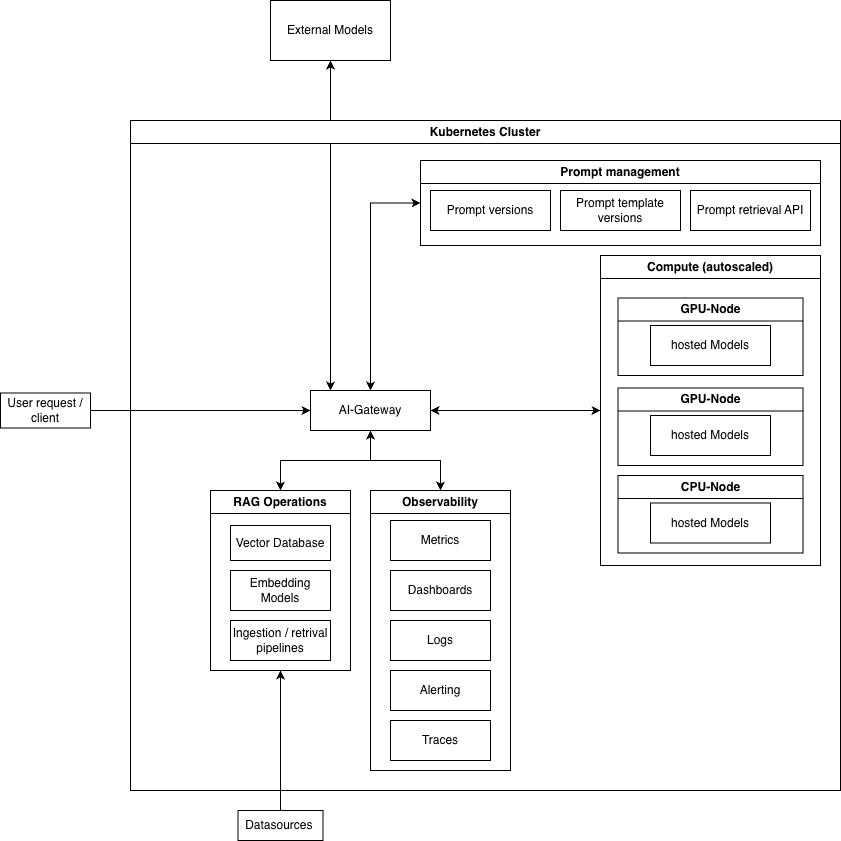
Alles beginnt mit einer Nutzeranfrage, die über das AI Gateway geleitet wird – unseren zentralen Einstiegspunkt für sämtliche LLM-Interaktionen. Dieses Gateway fungiert als einheitliche Abstraktionsschicht über mehrere Modellanbieter und Deployments hinweg. Es ermöglicht intelligentes Routing, Load Balancing, Fallback-Strategien und Request Shaping und sorgt so für Resilienz und Flexibilität. Die angebundenen LLMs können extern gehostet sein (etwa über OpenAI, Anthropic, AWS Bedrock) oder intern auf Cloud-GPUs, verteilten Rechenclustern oder sogar On-Premises-Infrastruktur betrieben werden.
Ein zentraler Enabler dieser Architektur ist Kubernetes (k8s) als Orchestrierungsschicht für das Bereitstellen, Skalieren und Verwalten der LLM-Dienste und unterstützender Komponenten. Kubernetes erlaubt es uns, Deployments über Umgebungen hinweg zu standardisieren, GPU-Ressourcen effizient zu nutzen, Autoscaling für Inferenz-Workloads umzusetzen und eine hohe Verfügbarkeit kritischer Dienste wie AI Gateway, Embedding-Pipelines und Vektordatenbanken sicherzustellen. Zudem vereinfacht es den Betrieb hybrider Setups, in denen selbst gehostete und externe Modelle nebeneinander bestehen.
Dank des AI Gateways verfügen wir über eine Abstraktionsschicht, die Vendor Lock-in und anbieterspezifische Eigenheiten ausräumt. Die LLMs greifen auf ein Prompt-Management-System zu, um die verschiedenen Prompts und Prompt-Templates in unterschiedlichen Versionen in Echtzeit abzurufen. Auch die Anbindung an unsere RAG-Operations erfolgt über das AI Gateway. Der Observability-Stack sammelt Signale aus dem gesamten System, einschließlich Hardwareauslastung und spezialisierter Metriken der zugrundeliegenden Inferenz-Engine. Das AI Gateway meldet Tokenverbrauch, Kosten und API-Aufrufe an den Observability-Stack und erzeugt so ein umfassendes Bild des aktuellen Zustands der LLMOps-Plattform.
Zusammenfassung
LLMOps bringt die Disziplin des Platform Engineering in KI-Systeme, indem es große Sprachmodelle produktionsfähig macht. Es deckt den gesamten Lebenszyklus rund um Prompts, Modelle, Gateways, Observability, Kostensteuerung und Retrieval-Systeme ab, damit LLM-gestützte Anwendungen zuverlässig, sicher und effizient skalieren. In der Praxis geht es bei LLMOps nicht nur darum, Modelle zu betreiben, sondern darum, das operative Fundament zu schaffen, das aus experimentellen KI-Features stabile Unternehmenssoftware macht.
Wenn Sie Potenzial sehen, Ihre bestehende Plattform um LLMOps-Fähigkeiten zu erweitern, oder gezielte Beratung zur Integration von LLMOps in Ihre Abläufe benötigen, sprechen Sie uns gerne an – wir erläutern Ihnen alles Weitere und arbeiten gemeinsam an Ihren Zielen.
Teilen