
Four days of hacking in Potsdam
published at 08-04-2026 by Max Körbächer
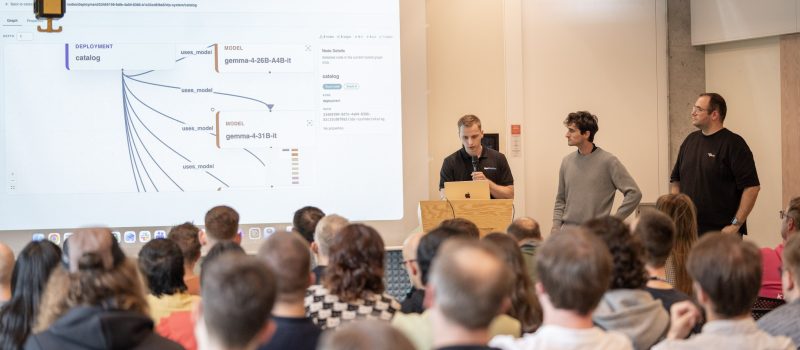
From 21st to 24th of July, the Naira team joined multiple open-source projects from the ApeiroRA and NeoNephos ecosystem in the SAP Innovation Center in Potsdam for a four-day hackathon. Our goal was simple to state and a lot more fun to build: bring sovereign inference and AI engineering closer together and figure out where the pieces of the wider ecosystem actually fit.
Four days later, we left with two working results and a much sharper picture of the road ahead. The personal exchange across all projects cleared the way and opened up possibilities we can take.
A Thalamus plugin and an abstraction for any OpenAI-compatible service
Thalamus is a vendor-neutral, Kubernetes-native inference service for sovereign LLM deployments, where weights, prompts and context never leave the deployment perimeter. That makes it a natural fit for Naira, whose job is to discover, govern and operate AI assets and services in one place.
We started by implementing a dedicated Thalamus plugin for Naira, so models served by Thalamus show up as first-class, governed assets in the hub. As the plugin is based heavily on OpenAI API compliance, we took this further by pulling it apart and generalizing it into an abstraction for any OpenAI API-compliant service. Thalamus is now one implementation behind that interface and anything else speaking the same API can be plugged in without a new integration from scratch.
This is exactly the kind of thing that is hard to get right in a design document and surprisingly easy to get right when both teams are sitting at the same table.
An MCP server for Naira, plus a chatbot
The second track was about how people actually use our platform. We built an MCP server for Naira and integrated a simple chat (OpenWebUI) on top of it, so you can work with the platform conversationally: ask what's available, inspect assets and trigger actions without leaving the chat. It is early and deliberately minimal, but it changes how the platform feels to work with and it gives us a concrete artifact to iterate on rather than a slide.
However, the true potential comes with more information we gather. A big challenge will be correlating that information and keeping it accessible.
Drawing lines to kcp, Platform Mesh and OCM
Beyond writing code, a portion of the four days was spent in conversations with neighboring projects like kcp with Platform Mesh and OCM.
These discussions were less about integration for its own sake and more about drawing clean lines, but also boundaries: which concerns belong to multi-tenant control planes and API management, which to component description and transport and which genuinely belong in an AI engineering hub like Naira. Being in one room with the people who own those answers saved us what would otherwise have been weeks of asynchronous back-and-forth and, in a few cases, kept us from building something that already exists one layer down.
What is Naira
Naira is an open-source AI Engineering Hub that connects existing AI tools into one place to discover, govern and operate AI assets and services and their related components.
It does not replace the systems where AI work happens. Instead, it makes the AI engineering landscape understandable, connected and actionable for the teams that need to build and run AI-enabled software in production.
Naira brings together the context that AI engineering teams need across the lifecycle of AI-enabled systems.
At the center is a connected view of important AI and software entities, such as:
- models and model versions;
- datasets and data sources;
- inference endpoints;
- MCP integrations;
- AI gateway routes;
- software components and applications;
- workspaces and ownership;
- documentation and runbooks;
- observability links and operational signals;
- plugin-provided metadata and actions.
The goal is not to move all data into a new monolith. The goal is to connect to the systems that already exist and make their context usable.
What's next
The Thalamus plugin and the OpenAI-compatible abstraction give Naira a sovereign inference path. The MCP server opens up a conversational way into the platform. Both are early, both are open and both are better for having been built together rather than in parallel.
Thanks to everyone who joined in Potsdam and to SAP for organizing and their Innovation Center for hosting.
Naira, Thalamus, kcp, Platform Mesh and OCM are all part of the ApeiroRA and 8ra activities, funded by the EU IPCEI-CIS and supported by companies such as SAP, who also sponsored this hackathon.